Dog trainer and Separation Anxiety Specialist | Dog Home Alone
Online separation anxiety support for dogs everywhere
Why You May Need a Separation Anxiety Specialist (And Why General Dog Training Often Isn’t Enough)
If you’re searching for help with your dog’s separation anxiety, chances are you have already tried to solve this on your own. You’ve watched videos, read articles, downloaded guides, and maybe even worked with a general dog trainer, yet every time you close the door, your dog still panics.
At some point, most guardians ask themselves: Do I really need a separation anxiety specialist, or should I just keep trying harder?
It’s a fair question, and it deserves an honest answer.
Separation anxiety in dogs is one of the most misunderstood behavioral issues, because on the surface it can look like disobedience, frustration, or even attention-seeking behavior. In reality, true separation anxiety is rooted in fear, and fear behaves very differently from a simple training gap. Understanding that difference is the reason specialized support matters.
What Separation Anxiety in Dogs Actually Is
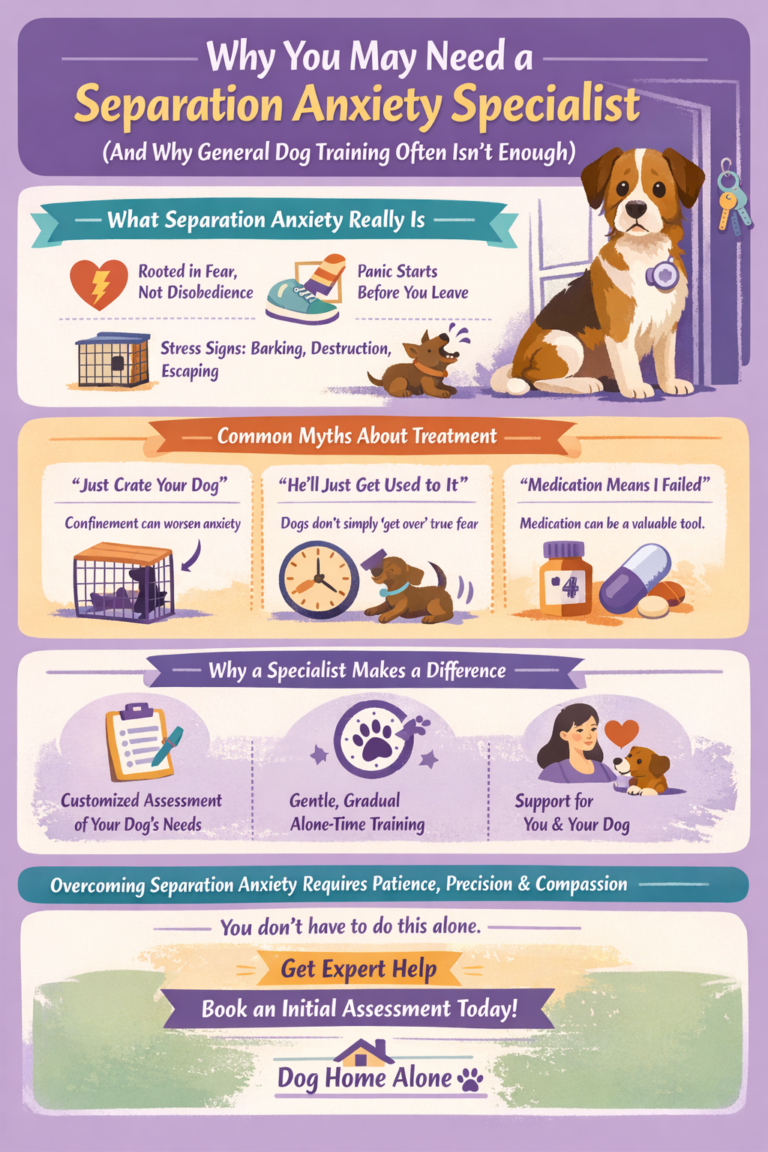
When a dog has true separation anxiety, being alone does not simply feel boring or frustrating: it feels unsafe. The dog’s nervous system activates a stress response that can manifest as barking, howling, pacing, destructive behavior, salivating, attempting to escape, or even injuring themselves while trying to get out.
However, one of the most important things people misunderstand is that the panic does not begin when the barking starts.
In many cases, the stress response begins much earlier, when you pick up your keys, put on your shoes, close your laptop, or shift your routine in subtle ways that signal your departure. By the time your dog is vocalizing or scratching at the door, their nervous system is already overwhelmed.
If you repeatedly leave your dog longer than they can cope with (even if it is only “a few extra minutes”) you are not building independence. You are strengthening the fear pathway in the brain. This is why dog separation anxiety training must be handled differently from obedience training, and why progress often stalls when the underlying emotional state is not addressed.
Common Myths About Separation Anxiety Treatment
“Just crate your dog.”
Crates can be incredibly useful tools for many dogs in many contexts, but confinement does not automatically resolve fear. If the anxiety is rooted in being separated from a trusted person, reducing the dog’s space does not remove the emotional trigger. In fact, for some dogs, confinement intensifies the feeling of panic because it removes their ability to move freely while they are already distressed.
A separation anxiety specialist evaluates whether confinement is helpful, neutral, or harmful for each individual dog rather than assuming one solution fits all.
“He’ll eventually get used to it.”
This idea is widespread and unfortunately damaging. Dogs do not habituate to overwhelming fear through repetition in the way many people hope they will. Instead of becoming calmer, many dogs become more sensitized, meaning the anxiety response intensifies over time.
When full panic episodes happen repeatedly, the brain becomes more efficient at producing that panic. This is one of the reasons why leaving a dog alone in hopes that they will “figure it out” often leads to worsening symptoms rather than improvement.
“Medication means I failed.”
This belief keeps many dogs unnecessarily struggling.
With my own dog, I trained consistently for two years without medication because I believed I should be able to solve it behaviorally. We made minimal progress despite careful work. When I finally decided, in collaboration with a veterinarian, to support his nervous system with medication, everything shifted. His learning capacity improved, his threshold increased, and progress became both faster and more stable.
Medication is not a shortcut, nor is it about sedating a dog into compliance. For some dogs, it reduces the intensity of fear enough that true learning can take place. A separation anxiety specialist understands when behavioral modification alone is appropriate and when additional support may significantly reduce suffering.
What a Separation Anxiety Specialist Does Differently
One of the main differences between general dog training and specialized separation anxiety treatment is the scope of assessment. A specialist does not look only at the absence exercises themselves but evaluates the entire context of the dog’s life.
Before structured alone-time training begins, I assess sleep quality, daily stress levels, breed-specific needs, decompression opportunities, exercise routines, household structure, and patterns of stress stacking. If a dog’s nervous system is overloaded throughout the day, expecting calm behavior during alone time is unrealistic.
Reducing overall stress often becomes the first phase of separation anxiety treatment. Only when the dog’s baseline arousal decreases can we begin carefully structured, gradual exposure to alone time in a way that keeps the dog below panic threshold.
This pacing is one of the most critical elements of success.
Why You May Need to Stop Leaving Your Dog Alone Temporarily
One of the most difficult but necessary steps in treating separation anxiety in dogs is temporarily preventing full panic episodes as much as possible. In order for a dog to learn that being alone is safe, they need fewer negative experiences, not more.
This might require adjusting schedules, asking friends or family for support, hiring a sitter, or bringing your dog along when feasible. While this period can feel inconvenient and emotionally exhausting, it is strategic rather than permanent.
Learning happens when fear remains manageable. When dogs are repeatedly pushed beyond their coping ability, trust erodes and progress slows dramatically. Specialized guidance helps determine how long this management phase should last and how to transition into structured training safely.
Progress Is Not Linear; And That Matters
Another essential aspect of working with separation anxiety is understanding that progress does not follow a straight line. Dogs have physiological fluctuations just like humans do. A dog who did well yesterday may struggle today because they slept poorly, experienced digestive discomfort, or encountered unexpected stress earlier in the day.
A separation anxiety specialist recognizes when to proceed and when to pause. Skipping a training session on a difficult day is not failure; it is respecting the biology of learning. Pushing through a bad day often creates setbacks that are larger than the perceived loss of time.
The Emotional Toll on Guardians
Separation anxiety does not only affect the dog; it deeply impacts the guardian’s life as well. Many people reach out feeling exhausted, judged by neighbors, limited in their ability to leave home, and ashamed that they “can’t fix it.”
They love their dog intensely, yet they feel trapped.
Part of specialized support involves helping guardians understand that this is not a reflection of poor training or weak leadership. It is a complex behavioral condition that requires structure, consistency, and often outside guidance. Supporting the human is an essential component of supporting the dog.
Can Separation Anxiety Be Cured?
Many guardians want to know whether separation anxiety in dogs can be cured completely. In many cases, dogs can learn to remain home alone calmly for meaningful periods of time. However, the ultimate goal is not simply extending duration.
The deeper goal is creating genuine emotional safety.
When a dog truly believes that they are secure and that their guardian reliably returns, alone time becomes a neutral or even restful experience. The most meaningful measure of success is not just how many hours a dog can stay home, but how relaxed they are while doing so.
Why Specialized Help Can Change the Outcome
Separation anxiety treatment requires careful observation of subtle stress signals, precise pacing of exposure exercises, and ongoing adjustments based on the dog’s responses. Without that precision, well-intentioned efforts can unintentionally reinforce fear.
Working with a separation anxiety specialist means you are not guessing about thresholds, duration increases, or whether progress is genuine. You are following a structured plan designed specifically for your dog’s nervous system and your real-life circumstances.
Most importantly, specialized work prioritizes trust over speed and safety over convenience.
If you are struggling with separation anxiety in your dog, know that this issue is not a reflection of failure, and it is not something you have to navigate alone. With thoughtful guidance, realistic pacing, and, when appropriate, medical collaboration, meaningful improvement is possible.
Separation anxiety is not a stubborn behavior problem: it is a fear-based condition, and fear deserves understanding, strategy, and patience.
If you’re living with separation anxiety right now and feeling exhausted, you don’t have to keep guessing your way through it.
Working with a separation anxiety specialist means having a clear plan, realistic pacing, and support when things feel messy or slow. It means understanding your dog’s nervous system instead of fighting against it.
If you’re ready for structured, compassionate guidance, you can book an initial assessment and we’ll look at your dog’s situation in detail and create a plan that actually fits your life.
You don’t have to do this alone. Book your Initial Assessment here or send us an email.