Dog trainer and Separation Anxiety Specialist | Dog Home Alone
Online separation anxiety support for dogs everywhere
How Is Having a Dog in Germany Different From Other Countries? Laws, Culture, and What Dog Owners Should Really Expect
Moving to Germany with a dog, or getting a dog after arriving, often feels like stepping into a completely different world. Germany is widely known as a dog-friendly country, but what many people discover quickly is that it is also a country with strong expectations, detailed laws, and a very specific dog culture.
As a separation anxiety specialist and immigrant dog guardian myself, I experienced both sides of this reality: Germany offers incredible opportunities for dogs to thrive, yet it can also create pressure for dogs and guardians who don’t fit the “perfect dog” image. Understanding these differences helps you avoid frustration and build a life where both you and your dog can truly relax.
Germany Is Dog-Friendly — But Also Rule-Oriented
One of the biggest surprises for many international dog guardians is how integrated dogs are into daily life in Germany. In many regions, especially here in North Rhine-Westphalia (NRW), dogs are welcome in places that would be unimaginable elsewhere.
Dogs commonly accompany their guardians to:
Restaurants and cafés
Public transportation (trains, trams, buses)
Many shops and offices
Outdoor terraces and social spaces
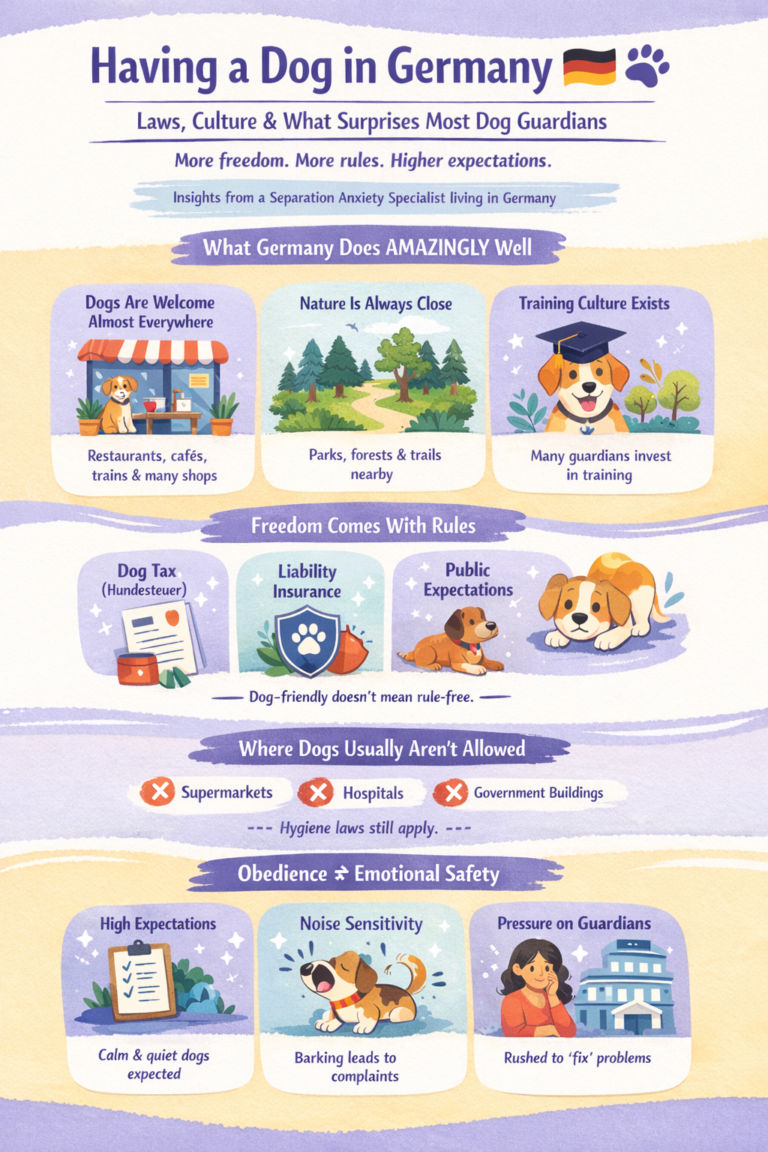
This inclusion allows dogs to experience the world regularly, which can be incredibly enriching when done thoughtfully. However, access comes with expectations: dogs are expected to behave calmly, quietly, and neutrally in public spaces.
There are also important exceptions. Dogs are generally not allowed in supermarkets, hospitals, or government buildings, and local rules always apply.
Leash Laws and Seasonal Rules Many Expats Don’t Know
Germany takes wildlife protection and public safety seriously, which means leash rules are stricter than in many countries.
In cities, dogs usually must remain on leash unless you are in a designated Hundefreilaufzone (official off-leash area in parks). In forests, dogs are typically required to stay on leash during spring and early summer — roughly March through June — to protect wildlife during mating and nesting season. But course, not everyone follows these rules, but they exist.
Many newcomers assume rules are flexible, but enforcement can vary significantly depending on the region and local authorities and you can get a fine for not following them.
The Legal Responsibilities of Dog Ownership in Germany
Germany treats dog guardianship as a civic responsibility, not just a personal choice. Several legal requirements surprise international owners during their first months.
Common obligations include:
Dog Tax (Hundesteuer)
Every registered dog requires an annual municipal tax, regardless of size or breed.
Liability Insurance
Dog liability insurance is mandatory or strongly recommended in many states, covering damages or injuries caused by the dog.
Breed Regulations and Owner Tests
Some larger dogs require guardians to pass a theoretical knowledge test. While this demonstrates responsibility, it does not necessarily mean owners receive modern education about behavior or emotional welfare.
This distinction becomes important later.
Training Culture in Germany: Knowledgeable — Yet Sometimes Outdated
Compared to countries like Brazil, Germany has far greater awareness of dog training. Many guardians actively seek training classes, join dog sport clubs (Vereine), or participate in structured activities.
However, there is a paradox.
Many training environments remain heavily focused on obedience and control rather than emotional wellbeing. Dogs may learn to sit, stay, or walk politely past triggers, yet still feel unsafe or overwhelmed internally, what we call flooding.
A dog sitting calmly while another dog passes does not automatically mean the dog feels relaxed. Behavior and emotion are not the same thing, and confusing the two is one of the biggest cultural misunderstandings I observe.
Cultural Expectations: The “Perfect Dog” Standard
German society often expects dogs to be:
Quiet in apartments
Neutral toward strangers and dogs
Calm in restaurants and public transport
Comfortable staying home alone
These expectations create a stable social environment, but they can also place enormous pressure on sensitive or anxious dogs.
For example, excessive barking can lead to neighbor complaints, passive-aggressive notes, or even reports to local authorities (Ordnungsamt). Some municipalities even regulate acceptable barking duration, and there are welfare recommendations regarding how long dogs should be left alone.
For guardians working through separation anxiety, this cultural reality can feel overwhelming.
Why Separation Anxiety Feels Harder in Germany
Germany’s housing density and strong noise culture mean that dog anxiety rarely stays private. When a dog vocalizes, neighbors notice quickly, and guardians often feel judged or rushed to “fix” the problem.
This pressure leads many people to train too fast, unintentionally making anxiety worse.
One of the most helpful steps is simply communicating with neighbors and explaining that structured training is happening. Transparency often reduces conflict and buys the time necessary for humane progress.
You can learn more about the foundations of separation anxiety training here:
👉 Separation Anxiety Services
A Personal Case Study: My Own Dog’s Transformation
When I moved from Brazil to Germany, my own dog struggled with reactivity toward other dogs. In Brazil, people frequently allowed dogs to approach without asking, making it difficult to advocate for his space.
In Germany, I experienced the opposite. Distance between dogs is more socially acceptable, and structured environments allowed me to support his emotional safety consistently.
With predictable routines, respectful space, and gradual exposure, his behavior improved significantly. Today, he enjoys daily adventures, agility training, and calm social interactions that once felt impossible.
The environment did not fix the problem alone, but it created conditions where good training could finally work.
What Germany Does Exceptionally Well for Dogs
Despite its strict reputation, Germany offers remarkable advantages for canine wellbeing.
Easy access to nature close to urban areas
Dogs included in everyday social life
Affordable training clubs and sport opportunities
High-quality dog equipment and food availability
Communities that genuinely love dogs
Many dogs develop richer, more stimulating lives simply because they are allowed to participate in daily routines.
Where Germany Can Be Challenging for Dogs
At the same time, perfectionism can become a problem.
Some guardians focus so strongly on obedience that they forget relationships, emotional safety, and agency matter just as much. Dogs are sometimes expected to behave flawlessly without enough understanding that learning (like for humans) includes mistakes, stress, and gradual progress.
Dogs do not need perfection; they need guidance and understanding.
Advice I Give Every New Dog Guardian in Germany
After working with many international clients, a few lessons repeat themselves constantly:
Learn to Say No
You are allowed to refuse greetings or interactions that overwhelm your dog.
Advocate for Your Dog
Your dog’s emotional safety matters more than social expectations.
Focus on Feelings, Not Just Behavior
A calm dog is not simply a quiet dog, it is a dog that feels safe.
If you’re unsure where to start, my free resources page can help:
👉 Free Dog Training Resources
You Don’t Have to Navigate This Alone
Living with a dog in Germany can be incredibly rewarding, but it can also feel isolating when your dog struggles to meet social expectations. Many guardians worry they are doing something wrong or that their dog is “difficult.”
In reality, most simply lack specialized guidance.
After working together, guardians usually feel comforted knowing they are not bad guardians or imagining the problem, and their dog finally experiences training that respects their emotional needs instead of pushing past them.
If you want personalized support tailored to your dog and your life in Germany, you can learn more here: