Dog trainer and Separation Anxiety Specialist | Dog Home Alone
Online separation anxiety support for dogs everywhere
How to Train a Dog with Separation Anxiety (Step-by-Step Guide)
If you are reading this, there is a very high chance you have already tried everything and are quietly wondering if this will ever get better. You have probably read blog posts, watched videos, bought enrichment toys, practiced short departures, and maybe even tried crating your dog because someone told you it would help.
And yet, your dog still panics when you leave.
Let me say this clearly: separation anxiety is not a training failure and it is not a sign that your dog is spoiled or manipulative. It is a panic response driven by the nervous system, and panic cannot be solved by pushing through it or hoping repetition will make it disappear.
The good news is that it is treatable when we approach it correctly and systematically.
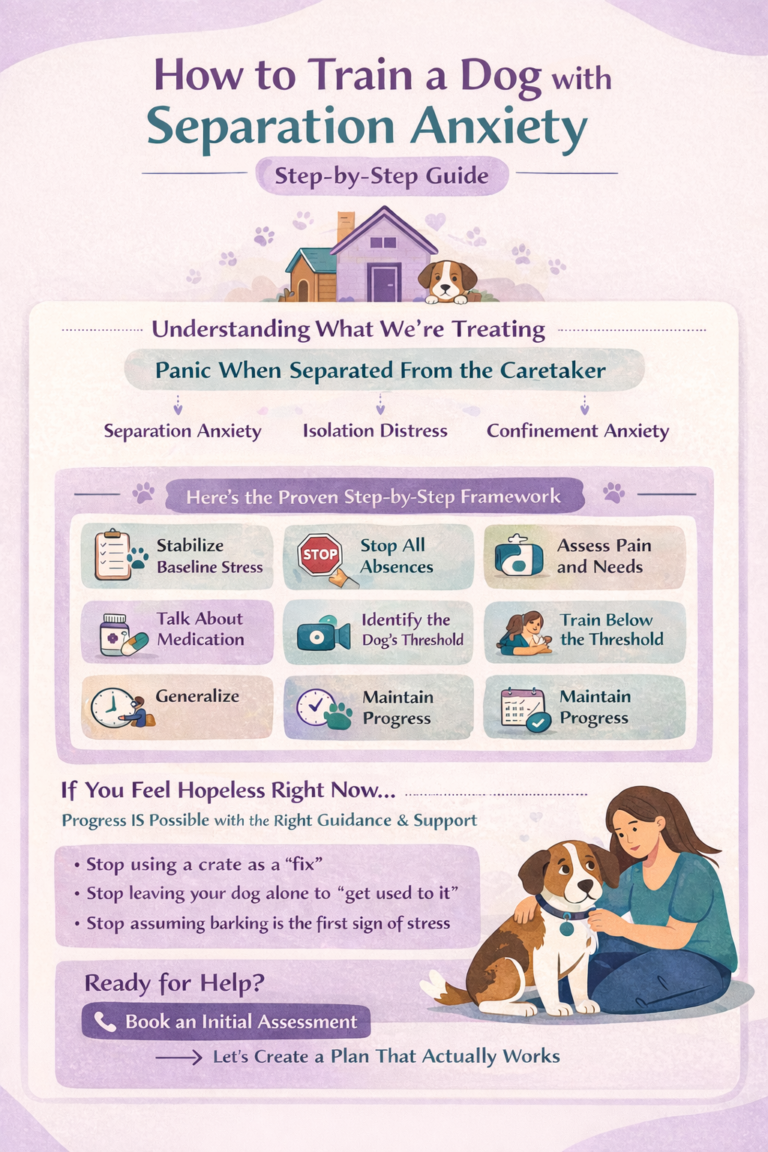
Understanding What We Are Actually Treating
Separation anxiety, isolation distress, and confinement anxiety are slightly different terms, but in practical life they often overlap in the same household. What they have in common is that the dog experiences real distress when separated from their attachment figure.
This is not boredom, and it is not simply a dog who prefers company. It is a nervous system that interprets separation as unsafe, which means the body reacts with stress hormones long before barking or destruction begin.
Many guardians assume the problem starts when the howling starts, but in reality the stress response often begins the moment you stand up, pick up your keys, or change your breathing pattern before leaving. If we do not recognize these early signals, we unintentionally train far past the dog’s actual threshold.
Why Most Separation Anxiety Training Fails
By the time people reach out to me, they are usually exhausted because they have been trying for months or even years without real progress. The most common pattern I see is that they were told to gradually increase time alone, but no one helped them identify where their dog’s true starting point actually was.
Another common mistake is using a crate as a solution rather than assessing whether confinement itself is part of the problem. For dogs with confinement anxiety, being crated can intensify panic because it removes the possibility of movement while the nervous system is already in fight-or-flight mode.
And perhaps the most damaging advice of all is to “just let them get used to it,” because panic does not extinguish through repeated exposure. Every full-blown episode of distress reinforces the fear pathway in the brain, which means we are rehearsing trauma instead of building resilience.
The Step-by-Step Framework That Actually Works
This is the structure I use with guardians who feel hopeless because nothing else has worked. It is not fast, and it is not flashy, but it is sustainable and rooted in how learning and stress physiology actually function.
Step 1: Stabilize Baseline Stress and Implement Management
Before we even begin departure training, we stabilize the dog’s overall stress level and prevent further panic episodes. This often requires temporary lifestyle adjustments, which may include coordinating schedules, arranging sitter support, or working from home strategically.
Training cannot progress while the nervous system is repeatedly pushed into survival mode. If we keep triggering full panic episodes during the week, we are undoing any small gains made during structured training sessions.
Step 2: Look at the Whole Dog, Not Just the Alone Time
One of the biggest mistakes in separation anxiety work is focusing exclusively on the door while ignoring the rest of the dog’s life. We have to ask whether the dog is experiencing pain, whether their breed-specific needs are met, whether they get decompression walks, and whether their daily life is full of low-grade stress.
A high-energy adolescent working breed living in an apartment without sufficient outlets will struggle far more than a dog whose physical and mental needs are consistently met. When the baseline stress decreases, the capacity to cope with separation increases.
Step 3: Stop All Absences That Trigger Panic
If your dog panics at two minutes, we do not practice five minutes in hopes of faster progress. We stop all absences that exceed the dog’s coping ability while we rebuild tolerance carefully and deliberately.
This step can feel overwhelming, especially for people who already feel trapped by the situation. However, it is temporary and foundational, because consistent sub-threshold work is what allows true learning to happen.
Step 4: Have an Honest Conversation About Medication
Medication is not a failure, and it does not turn your dog into a zombie when prescribed appropriately by a veterinarian. It lowers the intensity of panic so that the brain can remain in a learning state instead of a survival state.
With my own dog, I resisted medication for two full years because I believed we could train through it. We made almost no meaningful progress during that time, but once we introduced medication under veterinary guidance, his alone time increased substantially within a few months because his nervous system could finally process the training.
Some guardians prefer to try without medication first, and that is completely valid. However, if we see that training is consistently stalled despite correct pacing and management, it becomes an important and compassionate tool to consider.
Step 5: Identify the Dog’s True Threshold
During my Initial Assessment calls, I observe subtle body language signals that most people miss because they are looking for obvious behaviors like barking or scratching. The stress response usually begins with lip licking, yawning, scanning the room, freezing briefly, or increasing muscle tension.
By the time vocalization starts, the dog has already been over threshold for some time. Effective training begins at the earliest sign of stress, which sometimes means we start with simply standing up or touching the door handle before progressing further.
Step 6: Build a Sub-Threshold Training Plan
We increase alone time in very small increments, often measured in seconds rather than minutes at the beginning. The progression is determined by relaxation and body language, not by the guardian’s schedule or impatience.
This process requires patience because progress in separation anxiety work is rarely linear. Some weeks move smoothly, and other weeks plateau or temporarily regress, especially after life stressors or environmental changes.
Step 7: Add Supportive Enrichment and Skill Building
We do not only practice departures because a resilient dog is built through a balanced life. Confidence-building exercises, species-appropriate enrichment, and tailored activity plans all contribute to a more regulated nervous system.
Each training plan reflects the individual dog’s personality, age, and breed tendencies. What works for a calm senior companion will not be sufficient for an adolescent agility-driven dog who needs both mental and physical outlets.
Step 8: Generalization and Real-Life Integration
Dogs do not automatically generalize learning across contexts, which means being comfortable alone at 2pm does not guarantee comfort at 8pm. We gradually expand to different times of day, different durations, and sometimes different caregivers to ensure stability.
Over time, structured practice transitions into real-life absences. Maintenance then becomes about awareness and adjustment rather than constant formal training.
A Real Turning Point: My Own Dog
For two years, I trained consistently without medication because I believed persistence alone would solve the issue. We moved forward in tiny increments, but the overall capacity remained fragile and progress was painfully slow.
Once medication was added responsibly and paired with structured training, his tolerance increased substantially within months because his nervous system was no longer locked in chronic panic. That experience fundamentally changed how I approach severe cases today.
What You Should Stop Doing Immediately
Stop crating your dog as a quick fix without evaluating whether confinement contributes to the panic. Stop leaving them alone in hopes they will get used to it, because panic responses do not extinguish through repetition.
And most importantly, stop assuming that barking is the first sign of stress. By the time you hear noise, the nervous system has already been overwhelmed.
If You Feel Hopeless Right Now
Living with a dog who cannot be left alone is exhausting and isolating, especially when people around you minimize the problem or suggest simplistic solutions. It is normal to feel trapped, frustrated, or even resentful at times, and those feelings do not make you a bad guardian.
Separation anxiety is one of the most challenging behavioral conditions to manage, but it is treatable with the right pacing, structure, and support. You do not have to figure this out alone.
Ready for Structured, Professional Guidance?
If you want a personalized plan instead of guessing your way through online advice, you can learn more about my approach on the Separation Anxiety Services page. If you are ready to take the next step, you can book an Initial Assessment where we evaluate your dog’s body language in real time and build a realistic management and training plan together.
There is a path forward, even if it does not feel like it today. With the right structure and support, meaningful progress is absolutely possible.